

Why do some industries achieve excellence while others struggle endlessly with recurring equipment failures?
Because reliability is not a coincidence — it’s engineered deliberately through maintenance reliability engineering.
Understanding the Essence of Maintenance Reliability Engineering
Maintenance reliability engineering is the science and practice of improving the availability and performance of physical assets while reducing operational costs. It blends engineering principles, data analytics, and strategic maintenance planning to ensure that machines, systems, and infrastructures perform their intended function consistently over time.
In essence, this discipline is the foundation of a sustainable maintenance culture. By analyzing failure modes, defining preventive actions, and applying predictive technologies, reliability engineers prevent costly downtimes and extend asset lifecycles. Moreover, reliability-centered maintenance (RCM) strategies are often integrated into maintenance management systems (CMMS), ensuring accurate tracking and execution of maintenance plans.
The Strategic Role of Reliability in Modern Industries
 When properly applied, maintenance reliability engineering transforms the maintenance department from a reactive cost center into a proactive value generator. Through the systematic collection of equipment performance data, organizations can identify weak points and anticipate failures before they occur.
For example, in oil and gas, a small deviation in vibration readings may indicate bearing degradation long before a catastrophic failure. Similarly, in the energy sector, reliability-centered strategies ensure that turbines or transformers achieve optimal availability.
To dive deeper into industry benchmarks, the Society for Maintenance & Reliability Professionals (SMRP) provides valuable resources and certifications that strengthen engineering competence.
Key Pillars of Maintenance Reliability Engineering
 1. Data-Driven Decision Making
Modern maintenance relies heavily on analytics. Reliability engineers collect real-time data from sensors and predictive systems, using AI-powered algorithms to identify abnormal patterns. These insights enable condition-based maintenance (CBM), which minimizes unnecessary interventions and reduces costs.
2. Root Cause Analysis (RCA)
 When failures occur, it’s not enough to repair the symptom. RCA investigates underlying causes to prevent recurrence. Techniques such as the “5 Whys” or Fault Tree Analysis (FTA) help uncover systemic issues, improving long-term reliability.
3. Preventive and Predictive Maintenance
 Preventive maintenance follows scheduled intervals, while predictive maintenance uses real-time data to act only when needed. Combining both ensures operational balance and resource optimization.
4. Human Factors and Culture
 Maintenance reliability engineering also depends on people. Continuous training, cross-department collaboration, and knowledge sharing are essential to build a culture of reliability. As ISO 55000 emphasizes, asset management is a holistic process involving technical, financial, and human dimensions.
Integrating Reliability into Maintenance Engineering
To embed reliability principles into daily operations, maintenance engineers should adopt the PDCA (Plan–Do–Check–Act) approach. Planning includes identifying critical assets and defining performance indicators such as MTBF (Mean Time Between Failures) and MTTR (Mean Time To Repair).
During the execution phase, field data is collected and validated. Then, during analysis, engineers verify deviations and implement corrective actions.
Internal alignment is equally crucial — if your organization already uses a CMMS, integrate failure codes, inspection templates, and work order analytics for better traceability. You can explore our internal guide on Maintenance Optimization Strategies to learn how to automate reliability tracking within your operations.
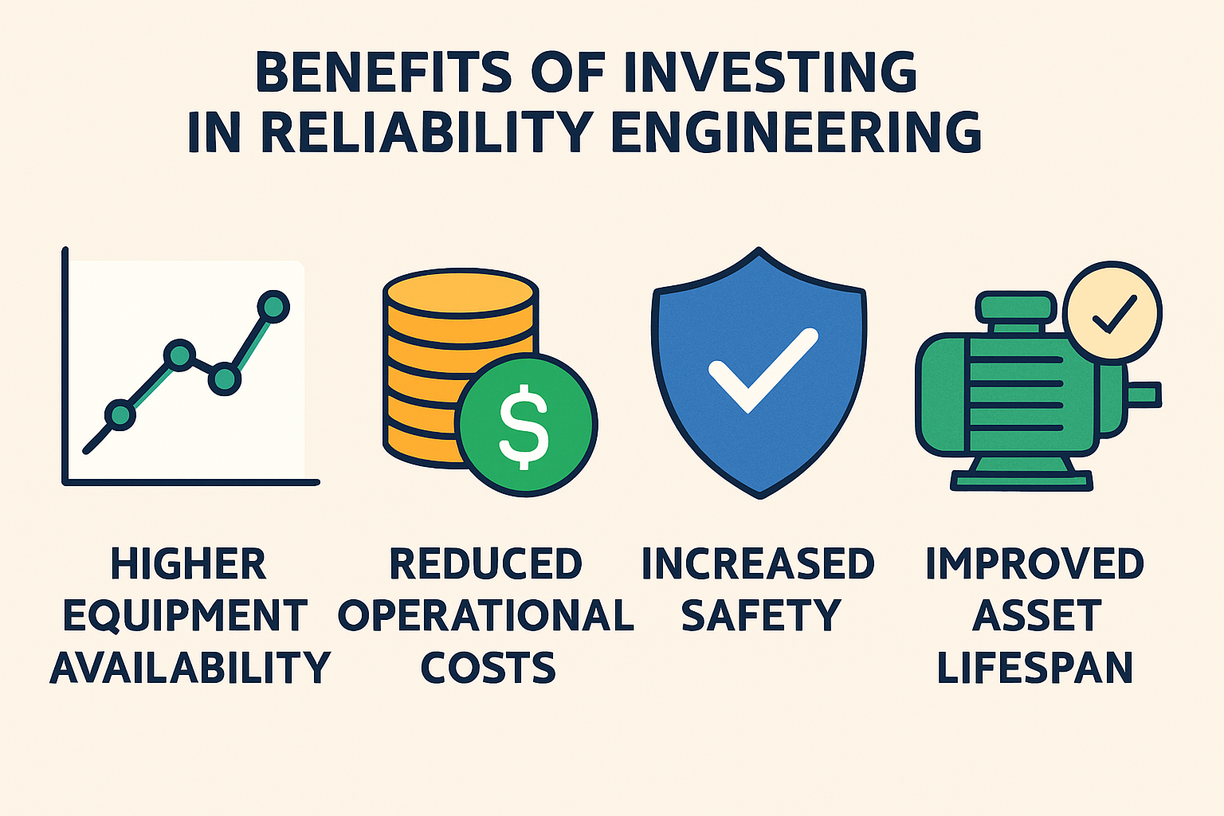
Benefits of Investing in Reliability Engineering
-
Higher Equipment Availability – Fewer unexpected shutdowns and smoother production flow.
-
Reduced Operational Costs – Optimized use of spare parts and labor.
-
Increased Safety and Compliance – Preventing hazardous failures and regulatory issues.
-
Improved Asset Lifespan – Extending the value of capital-intensive equipment.
-
Enhanced Decision Making – With accurate data, managers can plan confidently.
Each of these outcomes contributes directly to business competitiveness. Therefore, maintenance reliability engineering is not an expense; it’s a strategic investment.
Common Challenges and How to Overcome Them
 Many organizations still face obstacles when implementing reliability strategies. Resistance to change, lack of proper data, and insufficient communication between engineering and operations are common barriers.
To overcome them, leadership commitment is essential. Encourage transparency, provide training in reliability tools, and adopt digital platforms that promote data-driven collaboration. Over time, these actions reshape maintenance culture and deliver measurable results.
How Digital Transformation Is Shaping Reliability
 The rise of Industry 4.0 technologies — such as IoT sensors, machine learning, and digital twins — has revolutionized reliability engineering. These innovations enable predictive models that simulate equipment behavior, allowing maintenance teams to act before issues escalate.
In addition, AI-driven diagnostics help identify correlations invisible to human observation, creating a more accurate and agile maintenance strategy. However, digital tools must be accompanied by sound engineering judgment; technology amplifies expertise, but never replaces it.
Moving Forward with a Culture of Reliability
 Ultimately, maintenance reliability engineering is about building trust — trust in equipment, processes, and people. By integrating data, discipline, and continuous improvement, industries can achieve operational excellence and long-term sustainability.
So, whether you manage a manufacturing plant or a power generation facility, start applying reliability principles today to elevate performance and resilience.
FAQ – Frequently Asked Questions
Below are the most common doubts about maintenance reliability engineering and its practical applications.
What is the main goal of maintenance reliability engineering?
Its main goal is to maximize equipment availability and performance while minimizing costs and unplanned downtime.
What’s the difference between reliability and maintenance?
Maintenance focuses on restoring equipment, while reliability focuses on preventing failures and improving performance over time.
How does predictive maintenance support reliability?
Predictive maintenance uses sensors and data analytics to forecast failures, allowing engineers to intervene before damage occurs.
Which tools are most used in reliability analysis?
Common tools include FMEA, RCA, Weibull analysis, and condition monitoring systems integrated into CMMS software.
Is maintenance reliability engineering only for large industries?
No. Any organization that relies on equipment — from small factories to utilities — can benefit from applying reliability principles.
