
A car is never just a machine—it is the physical translation of human dreams into engineering reality.
The vehicle design process is the structured pathway through which ideas become prototypes and prototypes evolve into road-ready machines.
Why the Vehicle Design Process Matters
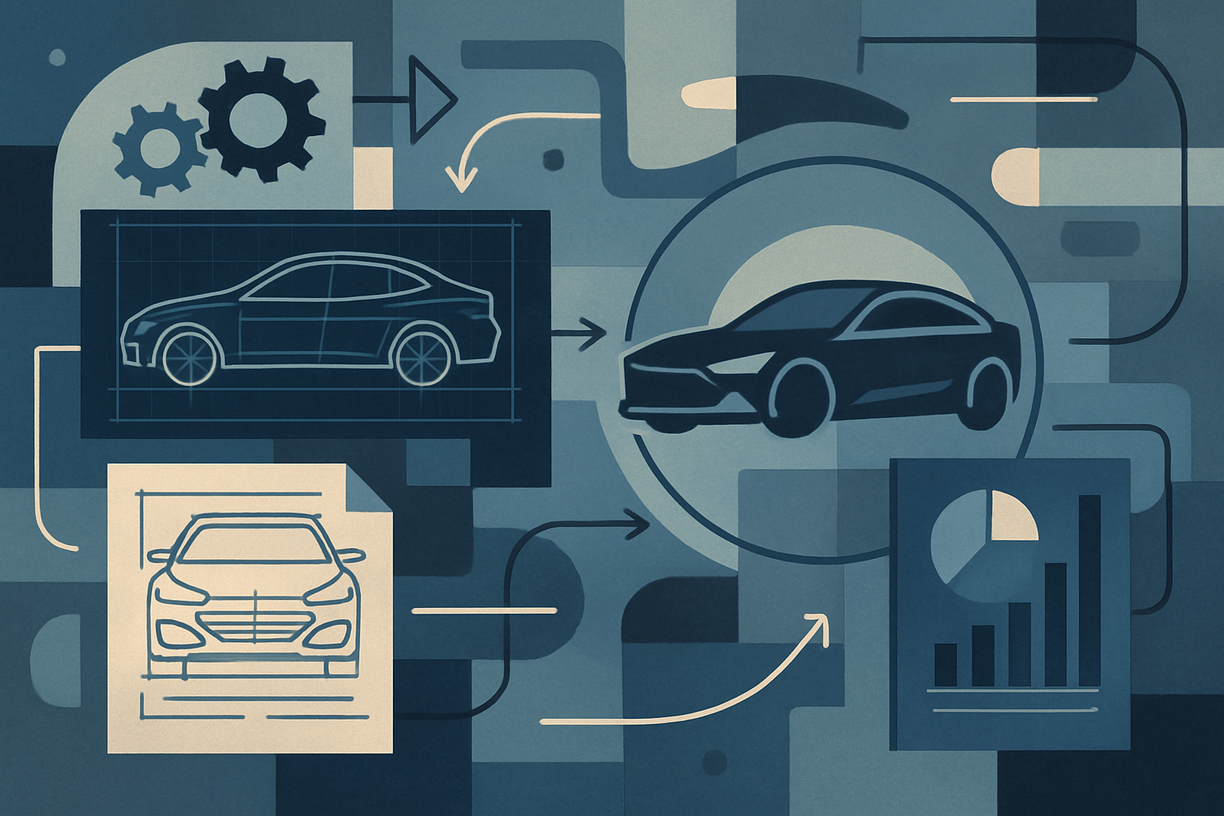
The vehicle design process is more than just a technical checklist; it is the strategic foundation of the entire automotive industry. A vehicle is not only a means of transportation but also a symbol of identity, lifestyle, and technological progress. Without a structured design process, it would be impossible to ensure consistency, safety, and innovation across millions of vehicles produced every year.
In practice, the vehicle design process creates alignment between different disciplines such as engineering, marketing, ergonomics, and sustainability. For instance, when a company decides to launch a compact electric SUV, the design process must address not only the mechanical architecture but also the expectations of urban customers who value connectivity, environmental responsibility, and cost efficiency.
Furthermore, regulations are growing stricter each year. Agencies such as the National Highway Traffic Safety Administration (NHTSA) in the United States and the European Union Mobility Authority demand precise compliance in areas like crash safety, fuel economy, and emissions. The vehicle design process ensures that these requirements are not treated as afterthoughts but are embedded in the DNA of the project from day one.
Another reason why the vehicle design process matters is the financial risk involved. Developing a new car can cost billions of dollars, and mistakes during the design stage can lead to catastrophic recalls or market failures. By following a structured methodology, automakers can minimize risks, identify problems early, and avoid costly redesigns during late production phases.
In addition, the process has a strong impact on innovation cycles. The faster and more efficient the design workflow is, the quicker automakers can respond to market shifts. Think about how Tesla accelerated the transition toward electric mobility: its ability to compress the design process allowed it to introduce EVs at a pace traditional companies struggled to match. This competitive edge is entirely dependent on mastering the vehicle design process.
Lastly, the design process matters because it serves as the link between consumer desires and engineering realities. People may dream of futuristic, stylish, and high-performance cars, but only through a disciplined design process can those dreams become tangible vehicles that meet safety, cost, and environmental expectations.
Key Stages of the Vehicle Design Process
The vehicle design process is a sequence of interconnected stages that transform an idea into a fully functional automobile. Each stage has its own goals, tools, and challenges, yet they all build upon one another. Skipping or rushing any of these steps often leads to poor performance, safety concerns, or high production costs. Let us examine the key phases in detail.
1. Concept Development
 Every vehicle begins with a concept. This stage of the vehicle design process is about defining what kind of product the company wants to create and why. Engineers, designers, and marketers collaborate to answer critical questions: Who will buy this car? What problem will it solve? What unique value will it offer compared to competitors?
During this phase, the team studies market research reports, consumer surveys, and competitor analysis. For example, if urban drivers are demanding smaller, electric-powered cars with high connectivity, the concept must reflect those needs. A failure to match the market often results in vehicles that nobody wants to buy, no matter how technically advanced they may be.
This stage also includes initial sketches and rough digital models. Designers explore proportions, silhouettes, and interior layouts, while engineers check whether the concepts are feasible from a structural perspective. At this point, creativity is encouraged, but boundaries such as budget, regulation, and manufacturing capacity must also be considered.
Concept development is crucial because it defines the vision that will guide the entire vehicle design process. Without a strong concept, the subsequent stages risk being misaligned or directionless.
2. Preliminary Design
 Once the concept is approved, the preliminary design phase translates ideas into concrete technical outlines. This stage relies heavily on Computer-Aided Design (CAD) tools to produce three-dimensional models that represent the vehicle’s geometry.
Designers refine proportions, focusing on details like headlight shapes, aerodynamic curves, and cabin space. Engineers, in parallel, evaluate structural feasibility, chassis layout, and packaging of major components such as the engine or battery pack.
Aerodynamics is a particularly important factor at this stage. Even subtle changes in the body design can reduce drag, improve fuel economy, and enhance performance. For instance, the sleek curves of the Tesla Model S were not just aesthetic choices but also aerodynamic optimizations born in the preliminary design stage.
Another key task here is ergonomics. Engineers analyze seat placement, steering wheel reach, and dashboard layout to ensure driver comfort and safety. If these aspects are ignored, the final product may look attractive but fail in practical usability.
By the end of the preliminary design stage, the vehicle design process produces a digital model detailed enough to proceed to engineering simulations.
3. Engineering Analysis
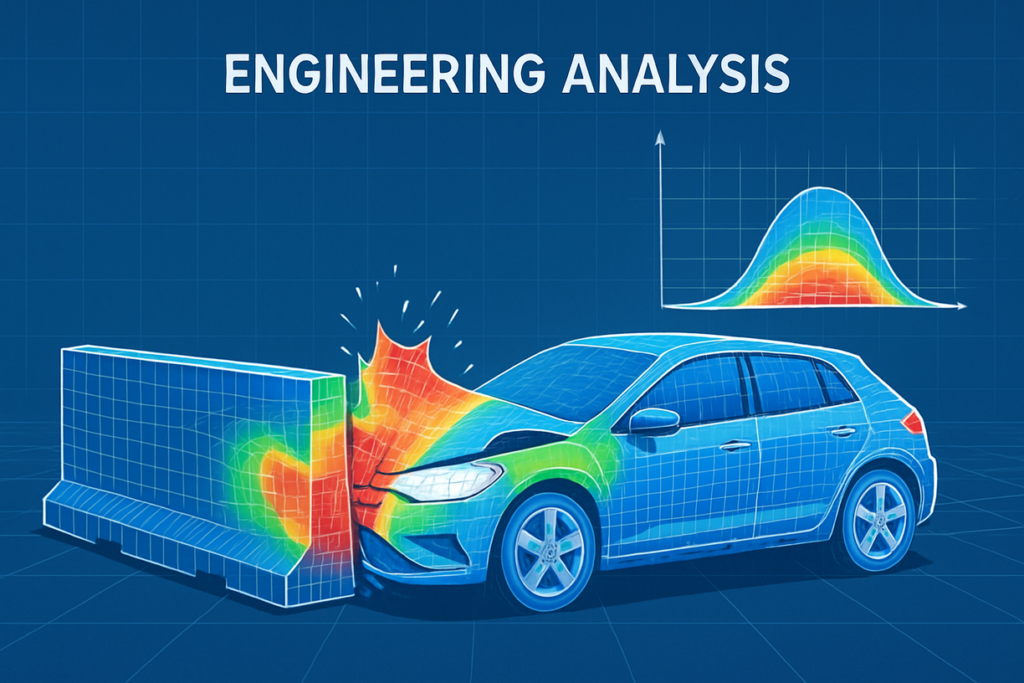
 Engineering analysis represents the backbone of the vehicle design process, ensuring that design ideas meet strict technical requirements. This phase uses advanced simulations and calculations to validate the vehicle’s structural integrity, efficiency, and safety.
Some of the most critical evaluations include:
-
Crash simulations: Digital crash tests simulate frontal, side, and rear impacts to verify passenger protection.
-
Aerodynamic analysis: Computational fluid dynamics (CFD) tools predict airflow around the car, minimizing drag and optimizing cooling.
-
Noise, Vibration, and Harshness (NVH): Engineers simulate how vibrations and road noise affect cabin comfort.
-
Thermal management: For electric vehicles, battery cooling is tested to prevent overheating.
These analyses reduce the need for physical prototypes early in the process, saving millions of dollars. For example, BMW is known for using digital twins—virtual replicas of their cars—that allow hundreds of simulations before building a single prototype.
At this stage, trade-offs become necessary. Engineers must decide whether to prioritize fuel efficiency, performance, or cost. This balance is at the heart of the vehicle design process, as no vehicle can maximize all parameters simultaneously.
4. Prototyping
 After simulations prove the design is feasible, the next stage of the vehicle design process is prototyping. A prototype is a physical model used to validate the digital assumptions in real-world conditions.
Prototypes may vary in fidelity:
-
Clay models for visual evaluation of aesthetics.
-
3D-printed components for testing fit and assembly.
-
Functional prototypes equipped with real engines, batteries, or autonomous sensors.
In fact, the automotive industry increasingly uses virtual prototypes through VR and AR systems. These digital mockups allow teams in different countries to collaborate without shipping physical models, speeding up the entire process.
During prototyping, ergonomics and usability are tested in detail. Engineers check if the driver has clear visibility, whether buttons are intuitive, and if passengers can comfortably enter and exit the vehicle.
The importance of this stage cannot be overstated. History offers examples of vehicles that failed commercially because prototypes were rushed. The Pontiac Aztek, often cited as one of the worst car designs, suffered from poor prototype evaluations that ignored consumer feedback.
5. Testing and Validation
 Even the best prototypes must undergo rigorous validation. This stage of the vehicle design process puts the car under extreme conditions to prove its reliability.
Testing includes:
-
Wind tunnel trials for aerodynamics.
-
Durability runs over thousands of miles in deserts, mountains, and icy roads.
-
Crash tests with physical dummies to confirm safety standards.
-
Electronics validation for autonomous and connected systems.
For electric vehicles, testing also focuses on battery performance, charging cycles, and fire safety. A single failure in this stage can cause recalls that damage brand reputation.
For example, before launching the Ford F-150 Lightning, Ford subjected prototypes to freezing temperatures in Alaska and scorching heat in Arizona. Only through such rigorous validation can manufacturers ensure vehicles meet global standards.
Testing and validation act as the ultimate filter, ensuring that the vision created in concept development truly survives real-world challenges.
6. Production and Launch
 The final stage of the vehicle design process is production and launch. This stage involves industrial engineering, supply chain management, and quality assurance.
Production engineers design efficient assembly lines that minimize waste and maximize output. Automation plays a key role here, with robots handling tasks like welding, painting, and component assembly. Human oversight remains essential for final adjustments and quality inspections.
Launch strategy is also vital. Marketing teams prepare campaigns to align with the car’s image, while dealerships receive training on the new product’s features. The coordination between technical readiness and market strategy is what makes the launch successful.
Once the vehicle is on the road, the process does not end. Feedback from customers, dealerships, and service centers feeds back into the next cycle of the vehicle design process, ensuring continuous improvement.
Trends Influencing the Vehicle Design Process
The automotive industry is evolving faster than ever, and the vehicle design process must adapt to new demands. Engineers are no longer focused only on fuel efficiency and aesthetics; they now face challenges tied to electrification, digitalization, and sustainability. Below are the most important trends reshaping the design workflow.
– Electric Powertrains
 The transition to electric mobility is arguably the most disruptive trend in the automotive world. For decades, the vehicle design process revolved around internal combustion engines. Today, however, electric powertrains demand a complete redesign of vehicle architecture.
Battery packs, for example, must be positioned strategically to balance weight distribution and safety. This often leads to a “skateboard” chassis design, where batteries sit flat under the floor. Engineers must also consider thermal management systems to prevent overheating and ensure consistent performance across climates.
Another major shift is in aerodynamics. Since range is a top priority for electric vehicles, designers work tirelessly to reduce drag. The smooth surfaces of the Lucid Air and Tesla Model 3 reflect how the vehicle design process prioritizes energy efficiency over traditional aesthetics.
Charging infrastructure and battery recycling are additional considerations that now influence early design decisions. Automakers cannot design EVs in isolation—they must consider the broader ecosystem in which the vehicle operates.
– Autonomous Systems
 The rise of autonomous driving also reshapes the vehicle design process in profound ways. Vehicles are no longer just machines controlled by drivers; they are becoming mobile computers powered by artificial intelligence.
Integrating sensors, LiDAR, cameras, and radar into the body design requires new approaches. Engineers must ensure these components are both functional and aesthetically integrated. Unlike conventional cars, autonomous vehicles cannot afford blind spots or sensor misalignment.
Inside the cabin, autonomy transforms user experience. Instead of focusing solely on driving comfort, designers now consider entertainment, connectivity, and even workspace layouts. Imagine a car where passengers hold meetings or relax while the vehicle drives itself. This vision forces the design process to move beyond mechanical engineering and embrace human-centered design.
Companies like Waymo and Cruise are already testing fully autonomous vehicles, and their design choices highlight how safety, redundancy, and digital integration dominate this new era.
– Sustainability and Materials
 Sustainability is no longer optional; it is a defining factor of the vehicle design process. Governments impose strict carbon neutrality goals, and consumers demand eco-friendly products. As a result, automakers are exploring new materials and manufacturing methods.
For instance, lightweight composites and recycled metals are increasingly used to reduce environmental impact. BMW’s i Vision Circular concept demonstrates how vehicles can be built almost entirely from recycled and renewable materials.
Moreover, the sustainability trend also affects supply chains. Automakers must ensure that raw materials, such as lithium for batteries, are sourced ethically and sustainably. This adds complexity to the early stages of design, where sourcing decisions influence both costs and brand reputation.
Energy-efficient manufacturing plants powered by renewable sources are another piece of the puzzle. The vehicle design process is now tied not only to the car itself but to the broader lifecycle, from production to recycling.
– Digitalization and Industry 4.0
Digital transformation is redefining how vehicles are designed. The vehicle design process now integrates technologies such as digital twins, virtual reality (VR), and artificial intelligence (AI).
Digital twins allow engineers to simulate an entire car virtually, running thousands of tests before building a single prototype. VR enables global teams to collaborate on the same model in real time, regardless of their physical location. AI, on the other hand, helps optimize aerodynamics, predict maintenance needs, and even design user interfaces.
This digitalization not only accelerates development but also reduces costs significantly. Automakers that adopt these technologies can bring cars to market faster while maintaining high quality.
– Connectivity and User Experience
Finally, modern vehicles are no longer isolated machines; they are connected platforms. The vehicle design process now includes considerations for over-the-air (OTA) software updates, advanced infotainment systems, and seamless smartphone integration.
Consumers expect vehicles to behave like smart devices, with intuitive controls, voice assistants, and real-time navigation. As a result, engineers collaborate more closely with software developers, blurring the traditional lines between automotive and tech industries.
Tesla, for example, has pioneered the concept of software-defined vehicles, where new features are added via software rather than hardware. This trend forces the design process to remain flexible, ensuring the vehicle can adapt over its lifetime.
Challenges in the Vehicle Design Process
Even with advanced tools, the vehicle design process faces challenges:
-
Cost Management: Balancing innovation with affordability.
-
Safety Standards: Meeting international crash and emission regulations.
-
Consumer Expectations: Blending style with performance.
-
Rapid Tech Evolution: Keeping up with digitalization and AI integration.
To overcome these, engineers must adopt agile frameworks, strong simulation platforms, and continuous learning strategies.
While modern tools and methods have advanced significantly, the vehicle design process remains full of challenges. Engineers and designers face a constant balancing act between performance, safety, cost, and sustainability. Below are some of the main obstacles that shape decision-making in today’s automotive industry.
– Balancing Performance and Efficiency
One of the toughest challenges in the vehicle design process is finding harmony between raw performance and fuel or energy efficiency. For traditional cars, this means optimizing engine output while meeting strict emissions regulations. For electric vehicles, the focus shifts to battery range versus weight.
Engineers often struggle with trade-offs: making a car faster usually requires more power, but this can compromise efficiency. Designers must use advanced simulations and materials to push the limits without sacrificing either performance or compliance.
– Safety Regulations and Compliance
Safety is non-negotiable in the automotive industry. The vehicle design process must incorporate strict global regulations, from crashworthiness to pedestrian protection. This often means extensive crash simulations, the integration of advanced driver-assistance systems (ADAS), and the use of crumple zones that absorb impact energy.
The challenge lies in meeting all these requirements without compromising aesthetics or cost. For example, incorporating large crumple zones may conflict with customer demands for spacious interiors. Engineers must constantly innovate to satisfy both safety regulators and consumer expectations.
– Cost Constraints and Market Pressures
Automakers operate in highly competitive markets. The vehicle design process must deliver innovation while staying within tight budgets. Advanced technologies such as carbon fiber, LiDAR sensors, or solid-state batteries may offer great advantages, but their costs can push vehicles out of reach for mainstream buyers.
Global supply chain fluctuations, especially in critical materials like semiconductors or lithium, add further uncertainty. Engineers must often redesign or adapt projects mid-development to cope with shortages, all while maintaining quality and safety.
– Complexity of Integration
Modern cars are no longer purely mechanical; they are complex ecosystems combining software, electronics, and mechanical systems. The vehicle design process must ensure seamless integration across all these domains.
For instance, adding autonomous features requires tight collaboration between software engineers and mechanical designers. A small misalignment between a sensor’s placement and the car’s aerodynamic flow could lead to performance issues or safety risks. Integration challenges multiply as vehicles become more connected and digital.
– Sustainability Trade-Offs
Although sustainability is a priority, it introduces additional complications into the vehicle design process. Using recycled materials or lightweight composites is beneficial for the environment but may introduce new durability concerns or higher production costs.
Likewise, sourcing ethical raw materials often limits supply options. Engineers must therefore make difficult decisions about whether to prioritize sustainability, performance, or affordability in each phase of design.
– Accelerated Time-to-Market
The pace of innovation in the automotive industry has never been faster. Companies race to bring new models, technologies, and features to market before competitors. As a result, the vehicle design process faces intense time pressures.
Shorter development cycles mean less room for error. Engineers rely heavily on digital simulations and virtual testing, but rushing also increases risks of design flaws slipping into production. Balancing speed with quality remains one of the most significant challenges of the modern era.
Future Outlook of the Vehicle Design Process
The future of mobility is being shaped right now, and the vehicle design process is at the center of this transformation. Engineers are not only solving today’s challenges but also preparing vehicles for the demands of tomorrow’s society. The next decade promises groundbreaking shifts in design philosophy, driven by sustainability, digital intelligence, and changing consumer expectations.
– Electrification Beyond Batteries
While battery-electric vehicles dominate current innovation, the vehicle design process will soon expand into alternative power sources. Hydrogen fuel cells, solid-state batteries, and even hybrid solutions will coexist to meet diverse market needs.
For instance, long-haul trucks may rely on hydrogen for efficiency, while compact city cars benefit from lightweight solid-state batteries. This variety means engineers must design flexible platforms capable of supporting multiple powertrain configurations. Flexibility, rather than specialization, will become a central principle in the future.
– Fully Autonomous Ecosystems
Autonomous driving will move beyond pilot programs and become a mainstream expectation. The vehicle design process will need to prioritize human-machine interaction (HMI) as much as mechanical design. Vehicles will be conceived as shared, mobile environments, integrating advanced AI for decision-making and comfort.
Designing interiors will become as important as exteriors, with layouts optimized for productivity, entertainment, or relaxation. Automakers may begin offering modular cabin options, where users can select different configurations depending on lifestyle needs.
– Integration of Smart Cities
In the coming years, the vehicle design process will not exist in isolation but as part of larger smart city ecosystems. Connected vehicles will communicate with infrastructure, traffic systems, and even energy grids.
Imagine vehicles adjusting their speed in real-time based on citywide traffic data or feeding energy back into the grid when parked. This requires new design considerations for connectivity, cybersecurity, and interoperability. Engineers must anticipate how vehicles interact not just with drivers but with entire urban networks.
– Sustainable Circular Design
Sustainability will evolve from a trend into a baseline requirement. The vehicle design process of the future will embrace circular economy principles, where vehicles are designed for disassembly, reuse, and recycling from day one.
Instead of treating end-of-life recycling as an afterthought, automakers will engineer vehicles for modular replacement and material recovery. This will not only reduce environmental impact but also create new business models based on refurbishment and component leasing.
– AI-Driven Creativity
Artificial intelligence will play a bigger role in accelerating innovation. Already, AI is used to optimize aerodynamics and predict consumer preferences. In the future, the vehicle design process will see AI collaborating with human engineers to generate concepts, simulate outcomes, and even suggest creative solutions that humans might overlook.
AI could analyze millions of design iterations in hours, drastically reducing development time. Human designers will shift toward supervision and refinement, ensuring that AI-driven designs align with safety, ethics, and brand identity.
– Personalized Mobility Solutions
Finally, the future points toward hyper-personalization. Consumers will expect vehicles tailored to their lifestyles, whether that means a sporty performance package, advanced health-monitoring systems, or custom digital experiences. The vehicle design process will incorporate modularity and digital customization, allowing cars to evolve over time without requiring physical replacements.
Conclusion
The vehicle design process is no longer just about building machines; it is about creating sustainable, intelligent, and user-centered mobility solutions. Engineers must balance performance, safety, and innovation while adapting to rapid technological changes.
If this topic inspired you, share your thoughts below, explore our related engineering articles, and join the conversation on how the next generation of vehicles should be designed.
FAQ – Frequently Asked Questions about the Vehicle Design Process
Below are some of the most common questions people ask about the vehicle design process, its steps, and its future.
What are the main stages of the vehicle design process?
The main stages include conceptual design, digital simulation, prototyping, testing, and final production. Each stage ensures that vehicles meet safety, performance, and regulatory standards before reaching consumers.
How is sustainability integrated into the vehicle design process?
Sustainability is achieved through lightweight materials, recyclable components, energy-efficient powertrains, and designing vehicles for end-of-life disassembly. Many automakers now adopt circular economy practices from the start.
Why is digital simulation important in vehicle design?
Digital simulation saves time and money by predicting performance and safety outcomes without building physical prototypes. It allows engineers to optimize aerodynamics, crash safety, and durability early in the process.
What role does artificial intelligence play in vehicle design?
AI helps accelerate decision-making by analyzing vast amounts of data, generating design alternatives, and predicting user preferences. It complements human creativity and reduces development cycles significantly.
How will autonomous vehicles change the design process?
Autonomous vehicles require new design priorities, such as advanced sensors, human-machine interfaces, and flexible interiors. The vehicle design process must shift focus from driving performance to user comfort, safety, and connectivity.